Rev. Walker. 1795
English, Nederlands
Nederlands
Eind 18e eeuw verbleef een zekere Rev. Walker een tijdje in Nederland en deed voor zijn Schotse thuisfront verslag over het kolfspel. Hij keek daarbij niet verder dan zijn neus lang was en publiceerde in 1795 een verhaal waarin hij het veel oudere colf aanzag voor toendertijd gespeelde indoor kolf. Rev. Walker is waarschijnlijk de oorzaak van de vermenging van de spelen colf en kolf in de Angelsaksische landen. Regelmatig is naar zijn uitspraken verwezen om aan te tonen dat colf niets met golf te maken had. Dit vanzelfsprekend tot grote geruststelling voor de Schotten!
De tekst van het artikel luidt:
English
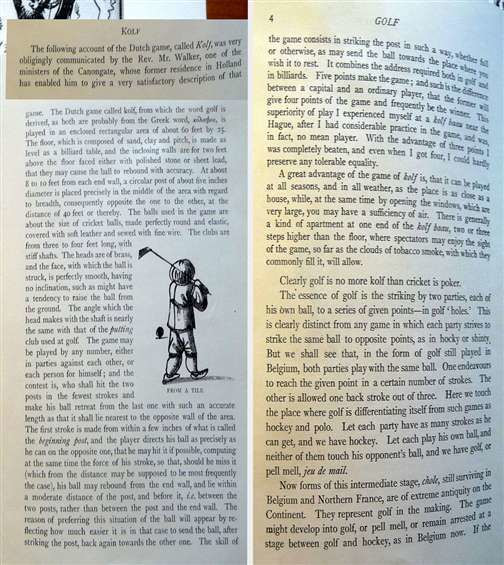
The following account of the Dutch game, called 'Kolf', was very obligingly communicated by the Rev. Mr. Walker, one of the ministers of the Canongate, whose former residence in Holland has enabled him to give a very satisfactory description of that game. The Dutch game called kolf, from which the word golf is derived, as both are probably from the Greek word Κόλαφος, is played in an enclosed rectangular area of about 60 feet by 25. The floor, which is composed of sand, clay and pitch, is made as level as a billiard table, and the inclosing walls are for two feet above the floor faced either with polished stone or sheet lead, that they may cause the ball to rebound with accuracy. At about 8 to 10 feet from each end wall, a circular post of about five inches diameter is placed precisely in the middle of the area with regard to breadth, consequently opposite the one to the other, at the distance of 40 feet or thereby. The balls used in the game are about the size of cricket balls, made perfectly round and elastic, covered with soft leather and sewed with fine wire. The clubs are from three to four feet long, with stiff shafts. The heads are of brass, and the face, with which the ball is struck, is perfectly smooth, having no inclination, such as might have a tendency to raise the ball from the ground. The angle which the head makes with the shaft is nearly the same with that of the putting club used at golf. The game may be played by any number, either in parties against each other, or each person for himself; and the contest is, who shall hit the two posts in the fewest strokes and make his ball retreat from the last one with such an accurate length as that it shall lie nearest to the opposite wall of the area.
The first stroke is made from within a few inches of what is called the 'beginning post', and the player directs his ball as precisely as he can on the opposite one, that he may hit it if possible, computing at the same time the force of his stroke, so that, should he miss it (which from the distance may be supposed to be most frequently the case), his ball may rebound from the end wall, and lie within a moderate distance of the post, and before it, i.e. between the two posts, rather than between the post and the end wall. The reason of preferring this situation of the ball will appear by reflecting how much easier it is in that case to send the ball, after striking the post, back again towards the other one. The skill of the game consists in striking the post in such a way, whether full of otherwise, as may send the ball towards the place where you wish it to rest. It combines the address required both in golf and in billiards. Five points make the game; and such is the difference between a capital and an ordinary player, that the former will give four points of the game and frequently be the winner. This superiority of play I experienced myself at a 'kolf baan' near the Hague, after I had considerable practice in the game, and was, in fact, no mean player. With the advantage of three points I was completely beaten, and even when I got four, I could hardly preserve any tolerable equality.
A great advantage of the game of kolf is, that it can be played at all seasons, and in all weather, as the place is as close as a house, while, at the same time by opening the windows, which are very large, you may have a sufficiency of air. There is generally a kind of apartment at one end of the kolf baan, two or three steps higher than the floor, where spectators may enjoy the sight of the game, so far as the clouds of tobacco smoke, with which they commonly fill it, will allow.
Clearly golf is no more kolf than cricket is poker.
The essence of golf is the striking by two parties, each of his own ball, to a series of given points - in golf 'holes'. This is clearly distinct from any game in which each party strives to strike the same ball to opposite points, as in hockey or shinty. But we shall see that, in the form of golf still played in Belgium, both parties play with the same ball. One endeavours to reach the given point in a certain number of strokes. The other is allowed one back stroke out of three. Here we touch the place where golf is differentiating itself from such games as hockey and polo. Let each party have as many strokes as he can get, and we have hockey. Let each play his own ball, and neither of them touch his opponent's ball, and we have golf, or pell mell, jeu de mail.
Nederlands
De verwijzing naar het Nieuwgriekse woord Κόλαφος is evenmin juist. Κόλαφος betekent weliswaar 'klap', maar in de betekenis van 'oorvijg' of 'klap in het gezicht'. Omdat colf en kolf nooit bekend zijn geweest in Griekenland (of andere Griekstalige gebieden) en golf daar pas in de negentiende eeuw is geïntroduceerd, moet worden aangenomen dat er geen Griekse oorsprong ligt in de etymologie van deze woorden.
Zie ook: http://books.google.fr/books?i... (vanaf pagina 28 onderaan).
Bron: Geert & Sara Nijs