Pieter Breughel II, Bagpipe player surrounded by children
English, Nederlands
English
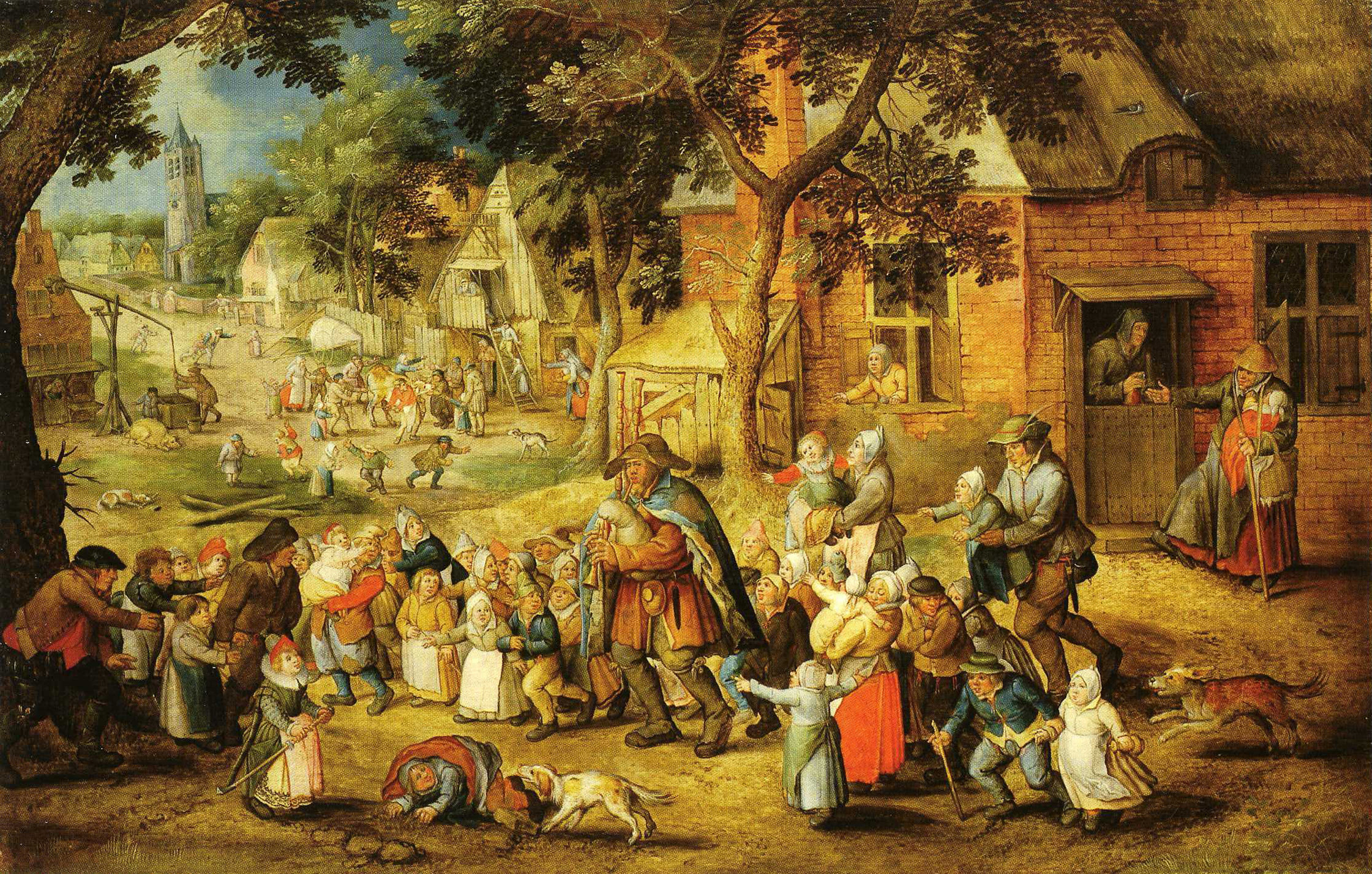
Bagpipe player surrounded by children by Pieter Breughel II the Younger
The work of Pieter Brueghel the Younger is dominated by earthy genre scenes constructed around anecdotal and picturesque elements. The artist captures groups of peasants with flawless technical skill and brilliant colour. These Rabelaisian compositions can also be read on a second level, offering a subtle social analysis of his age. In this rural landscape, with its rich and varied folk customs, after his father's example, Pieter Brueghel the Younger reveals a keen eye as an observer of real life and the ways of his fellow citizens.
The perfect technical mastery, vivid and fluid draughtsmanship and sparkling palette are all consistent with the signature of this master. In this composition, Bagpipe Player Surrounded by Children Brueghel devotes particular care to the physical features, details and folds of the clothing. The bright, highly contrasting palette is dominated by vermilion, blue and white which imbues the entire scene with great freshness and spontaneity.
The subject of the painting is the musician. A character commonly appearing in brueghelian compositions, the musician is almost never the main subject himself. The Bagpipe Player Surrounded by Children in fact depicts an itinerant beggar, who travels the country in search of alms. He is shown surrounded by a crowd of noisy children, in the centre of the village, enduring their pranks in the hopes of receiving a few coins. In the seventeenth century, musicians had barely any status; they were seen as accomplices of thieves and were quickly associated with the vagrants who infested the countryside in times of troubles. Adriaen van de Venne, the famous chronicler of the age, regarded them as thieves and bandits:
“They show up at any drunken gathering and play the lyre, flute or fiddle. And once the revellers are drunk and fall asleep, they pick their pockets: the lyre falls mute, the sense of touch being stronger than that of hearing, and these so-called musicians are nothing but greedy thieves."
Transformed into a clown, dressed in rags, he plays the bagpipes in the street to amuse children without arousing the slightest feeling of pity in the adults. Pieter Brueghel the Younger plunges us into the life of the travelling musician. The composition is known through different versions, which generally show a variation: the musician is usually depicted playing the fiddle. The composition attests to the inventive, playful spirit of the artist, as a skilful chronicler, able to perfectly capture the lives of ordinary people.
Brueghel became the trenchant historian of an entire segment of society in his age, creating realistic depictions of rural life. The artist's approach is sober and descriptive. Reflecting the moralising and didactic literature of his time, in his numerous genre scenes, his body of work celebrates the immense variety of nature.
Text: De Jonckheere Gallery
Oil on panel. 43,3 x 73,7 cm
Provenance
Private collection, Switzerland (Tefaf, Galerie De Jonckheere)
Nederlands
De Doedelzakspeler van Pieter Breughel II de Jonge (1564 - 1638).
Het jongetje met zijn deftige kleding en colf op de voorgrond is duidelijk misplaatst in dit boerentafereel.
Interessant is te zien dat in de 16de eeuw colf een echt volksspel was dat in de 17de eeuw is omarmd door de rijk geworden kooplieden. De colf was een exponent van het succes van de Republiek en de Gouden Eeuw. Caets en Malie werden in de ban gedaan als symbool van de aristocratie, het ancien regime, en metaforisch gelijkgesteld met verspilling en ijdelheid.
Olieverf op paneel. 43,3 x 73,7 cm
Particulier bezit, Zwitserland (Tefaf, Galerie De Jonckheere)
Bron: tekst Nederlands en afbeelding ^Robin Bargman
Literatuur
Georges Marlier, Pierre Brueghel le Jeune, Bruxelles, éditions Robert Finck, Bruxelles, 1969, p. 365-371.