Nennius of Nemnivus. Tweede helft achtste eeuw
English, Nederlands
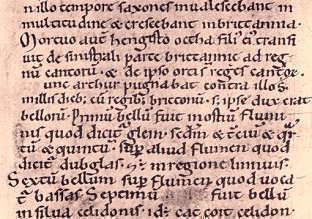
Afgebeeld is een fragment uit het oorspronkelijk manuscript van Nennius' 'History of the Britons'.
Goffrey of Monmouth gebruikte het manuscript 'Historia Brittonum' van Nennius of Nemnivus uit de tweede helft van de achtste eeuw als bron. En in een hedendaagse verzie van dit verhaal komt warempel weer een balspel voor op een veld:
41. In consequence of this reply, the king sent messengers throughout Britain, in search of a child born without a father. After having inquired in all the provinces, they came to the field of Aelecti (1), in the district of Glevesing (2), where a party of boys were playing at ball. And two of them quarrelling, one said to the other, "" boy without a father, no good will ever happen to you." Upon this, the messengers diligently inquired of the mother and the other boys, whether he had had a father? Which his mother denied, saying, "In what manner he was conceived I know not, for I have never had intercourse with any man;" and then she solemnly affirmed that he had no mortal father. The boy was, therefore, led away, and conducted before Vortigern the king.
(1) V.R. Elleti, Electi, Gleti. Supposed to be Bassalig in Monmouthshire.
(2) The district between the Usk and Rumney, in Monmouthshire.
(Bron: http://avalon.law.yale.edu/medieval/nenius.asp)
Onduidelijk is in hoeverre deze hedendaagse versie is beïnvloed door de stok-met-bal-versies van Robert de Boron en Jacob van Maerlant. Of heeft Robert de Boron niet alleen Geoffrey of Monmouth als inspirator gehad, maar ook Nennius?
Áls in de oorspronkelijke tekst, die ons niet ter beschikking stond, sprake is van een 'stok' en een 'bal' kan het natuurlijk niet anders dan een balspel zijn zoals dat in de achtste eeuw in Wales werd gespeeld. Omdat 'vertalers' van Middeleeuwse manuscripten altijd medievisten en taalkundige zijn en nooit kenners van oude balspelen en stok-met-bal-spelen, lijkt nader onderzoek op dit terrein naar de bronnen vóór Geoffrey of Monmouth, dus vóór het begin van de 12e eeuw gewenst.
Verder terug dan Nennius kan niet worden onderzocht: de bronnen uit de vijfde eeuw zijn verloren gegaan. Er wordt wel verondersteld dat Nennius het geschrift 'De Excido et Concquestu Brittammiae' van Gildas gebruikt zou hebben.
Bron: Sara & Geert Nijs, Do Smit