Johannes Stradanus, December. C. 1568-1578
English
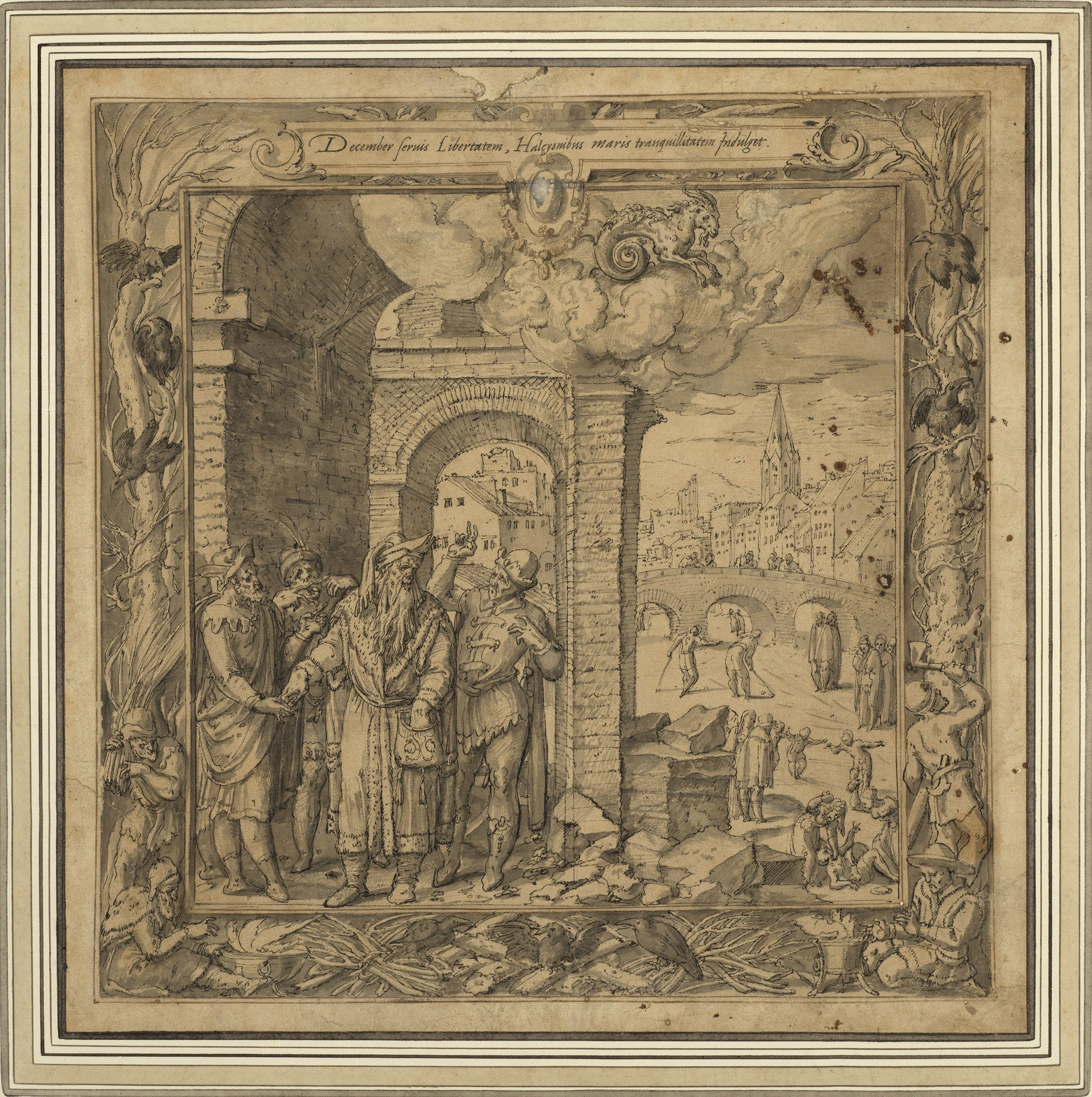
December, c.1568 - 1578, (style of) Johannes Stradanus (Bruges, 1523 - 1605, Florence)
A drawing of a group of men standing by an arch, with a view of a bridge over a frozen river with people playing, including colf, and a town in the background: beneath the arch a sick elderly man is paying his three servant, who are mocking him. In the sky above amidst clouds is the Goat (Capricorn).
The scene is surrounded by decorative borders with ravens and men felling trees and making fires, and there is an empty cartouche as in RCIN 906853. Inscribed within the upper border: December seruis Libertatem, Halcyonibus maris tranquillitatem Indulget.
This is a design for one of a series of tapestries (RCIN 906853-906860, RCIN 913024) illustrating the Months. Although these drawings form part of what are probably four series, almost certainly representing designs for tapestries, they are clearly by the same hand, or possibly hands. It should, however, be noted that Nicholas Turner suggests that they may be connected with Francesco Salviati. They are possibly related to tapestries for the Fabbrica degli Arazzi in Florence, founded by Cosimo de' Medici.
Johannes Stradanus, alias Jan van der Straet or Giovanni Stradano, was a Flemish artist active mainly in 16th-century Florence, Italy.
Pen and black ink with grey wash, with touches of white body colour | 40.0 x 40.0 cm (sheet of paper)
Provenance
First recorded in a Royal Collection inventory of c.1810 (Inv. A, p.126: '16. Eight of the Twelve Months of the Year. The Triumph of Spring and Winter, and six of Military Engagements, design'd for Tapestry's')
Acquirer(s)
• George III, King of the United Kingdom (1738-1820)
References
• W&C : White, C. & Crawley, C., 1994. The Dutch and Flemish Drawings at Windsor Castle, Cambridge – W&C 183
• P(F) : van Puyvelde, L., 1942. The Flemish Drawings in the Collection of His Majesty the King at Windsor Castle, London – P(F) 177
Royal Collection Trust, Great Brittain (RCIN 906860/631395-1473431493)
Source: Do Smit