Golf, H. Golt. 1706
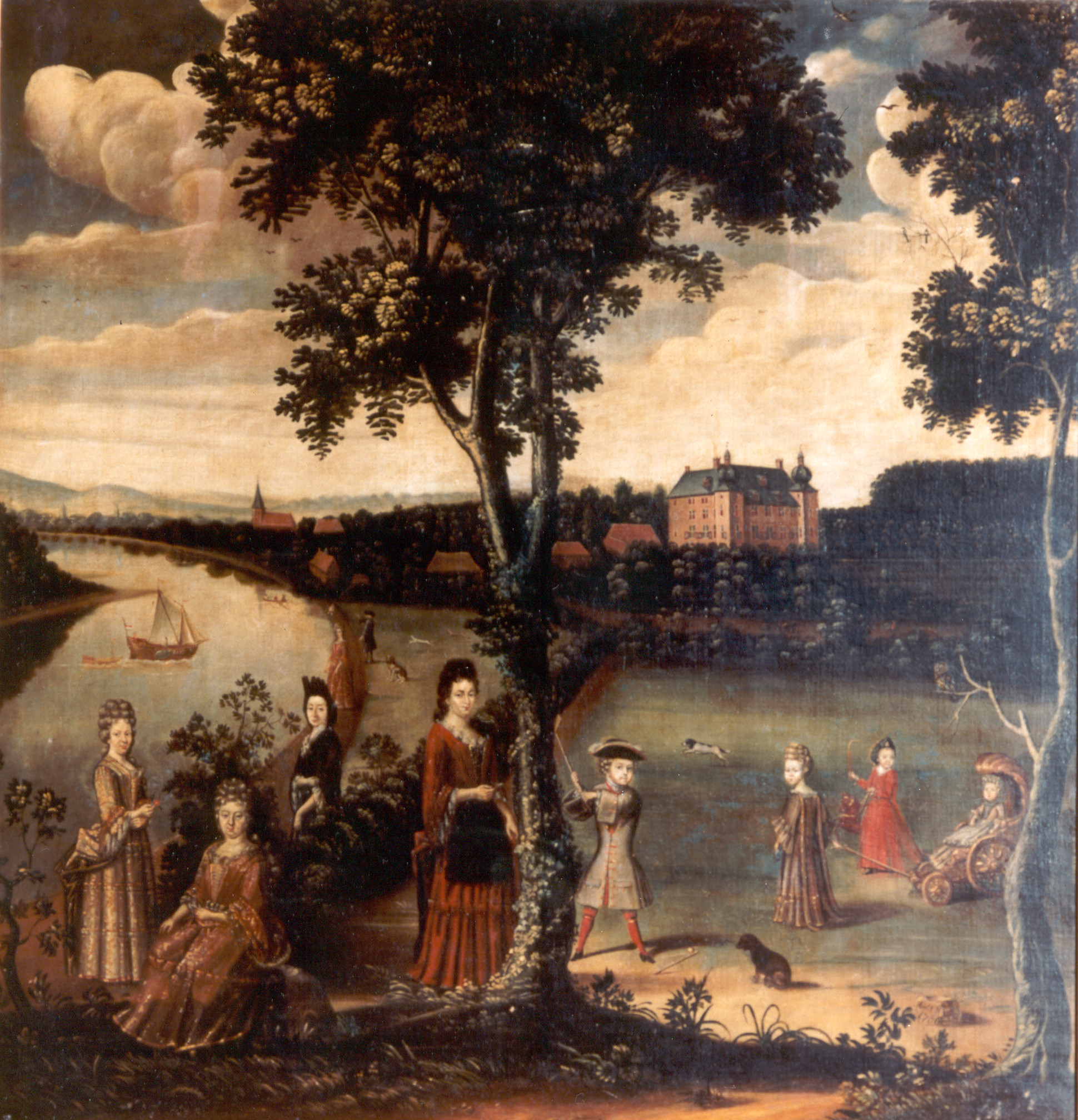
Land scape, 1706 by H. Golt (prob. H. Goltzius).
The painting is a view of Haus Wohnung, the residence of local nobleman, Johann Carselis of Ulft (who was also called by the last name of Doornick) in the vicinity of the town of Voerde on the Lower Rhine.
The original building dates back to a moated castle of the late Middle Ages but in its present state it reflects the architecture of the late seventeenth century when the owner had the whole building refurbished.
The figure views the two-towered building from the southwest and from a position on the eastern bank of the Rhine. In the lower right-hand corner, the date 1706 is inscribed on a stone; it is conceivable that Johann Carselis commissioned the painting to commemorate the completion of the extensive renovation of his residence. Equally, Carselis may have wished to express his gratitude towards his mother-in-law, the widowed Sophia Heilwig von Lynden, who had enfeoffed hin with the stately mansion. It is presumably she who is seated in a costly, festive red dress in the left-hand corner. Standing on her left, with identical coiffure to indicate a close relationship, her daughter Johanna Maria, the lord of the manor's wife, can easily be identified, as can his two unmarried sisters, Woltera Stephania and Elisabeth Katharine, who both lived at the residence. Woltera Stephania had died in February 1705, one year before Golt finished his painting, but her inclusion in the picture may have been a deliberate attempt to pay a lasting tribute to her.
The golfing scene is truly remarkable. The lord of the manor had devised a golf course to the south of his residence; a large rectangular hedged enclosure with a closely trimmed lawn. Under a tree in the remote corner of this enclosure, young Reiner Johann Theodor has teed his ball on a truly sophisticated contraption: a peg stuck into the turf at an angle which roughly anticipated the trajectory of the ball. The device apparently featured a concave top in which players deposited their ball before teeing off. It is conceivable that this device made it easier for a player to address the ball and to hit properly. Young Reiner is pictured taking a mighty swing at the ball. As befitted a young man of his status, he is wearing the clothes of an adult which, in turn, closely resemble the attire worn by the golfers on the earliest Scottish golfing pictures, the first of which is dated variously 1680 or 1720, and the second 1746/47.
The first Scottish picture is an oil painting by an unknown artist which depicts a gentlemen foursome and two caddies watching one of their fellows in his attempt to swing at the ball against the backdrop of the town of St, Andrews.
The second picture, a water-color by the Englishman Paul Sandby, shows a squad of soldiers fighting it out between them with a golf-ball in the shrubbery at the foot of Edingburgh Castle. Young Reiners's club is similar to those wielded by these Scottish golfers, or seventeenth clubs that have survived.
Olieverf
Source: Steag AG, Heiner Gillmeister, Robin Bargmann
Literature
- Golf on the Rhine: On the Origins of Golf, with Sidelights on Polo by Heiner Gillmeister. 2002.
Download
- Afbeelding in groter formaat (zie bijlage; bmp, 11.1 MB)