David Vinckboons, A quack selling potions and remedies in a square
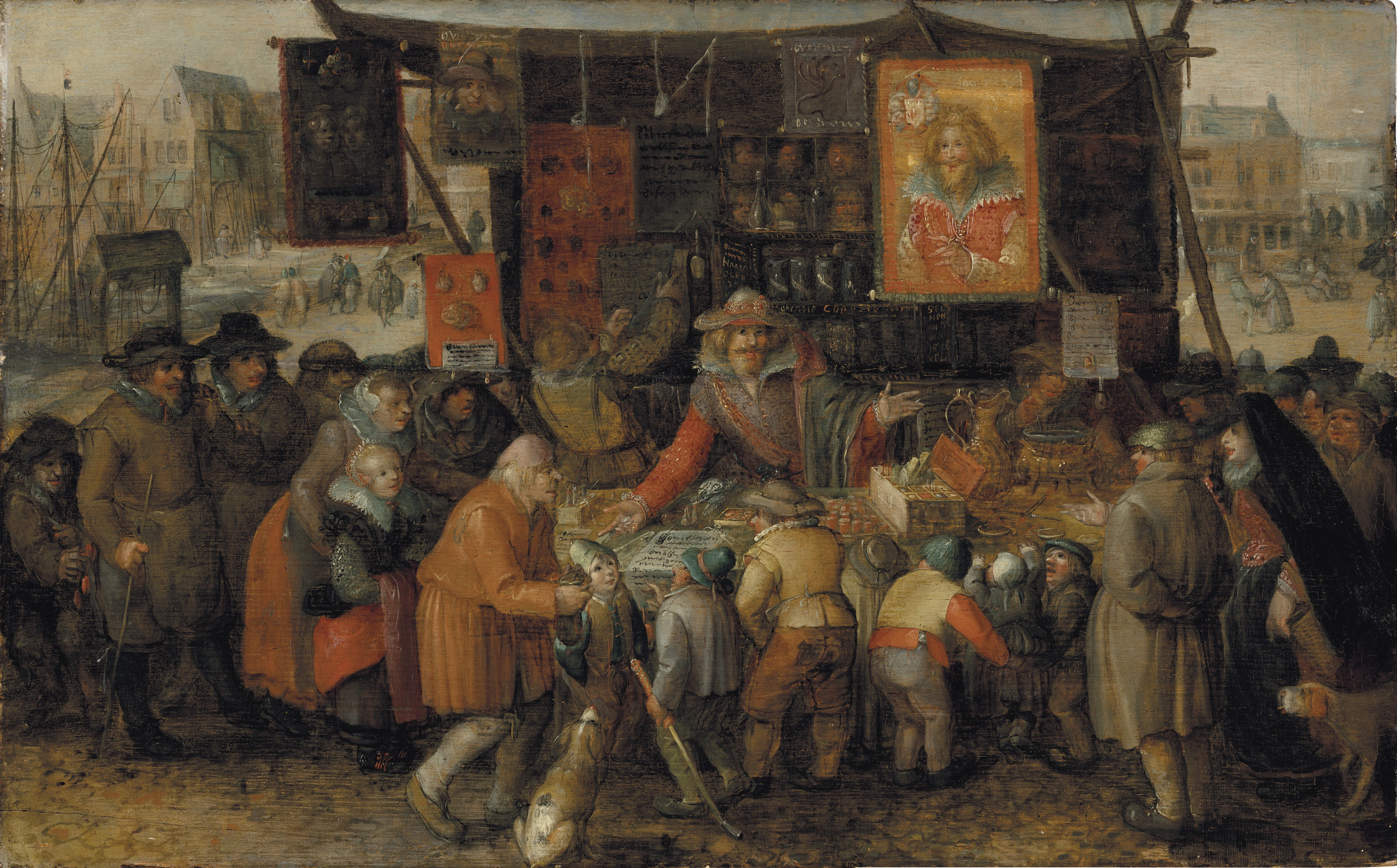
A quack selling potions and remedies in a square. David Vinckboons (Mechelen, 1576 - 1631, Amsterdam)
This undocumented work is a unique rediscovery in Vinckboons’ oeuvre, being the only known version of this composition by the artist, who was known to paint multiple copies of works for the open market. Indeed, the only hitherto known representation of this subject by Vinckboons was depicted in a vast landscape of merrymakers at a village fair, the prototype for which was a large drawing by the artist dating from 1602 (National Gallery of Denmark, Copenhagen), the year Vinckboons left Brabant to settle in Amsterdam. Engraved in reverse by Nicolaes De Bruyn (Rijksmuseum, Amsterdam), it was successively reproduced in prints by engravers in the subsequent decades. This ensured the composition’s wide distribution and popularity, from which resulted numerous painted copies, the oldest of which dates to 1608 (Herzog-Anton-Ulrich Museum, Brunswick), painted only around two years after the present work, dated to circa 1606.
The kwakzalver, or quack doctor, was often presented as a comic character in market scenes or kermesses, with a number of sixteenth and seventeenth century popular farces centred on the figure’s theatrical characterisations. Here depicted tricking naïve peasants into buying his ineffective remedies, this foolishness is echoed in figures like the pickpocket robbing the unaware bystander in the lower left of the picture. The earliest and most important iconography for the kwakzalver originated in folly imagery, such as Hieronymus Bosch’s The Cure of Folly (Museo del Prado, Madrid), and Pieter Bruegel’s engracings of The Lithotomists (Dean of Renaix) (1557) and The Sorceress of Malleghem (1559), which all focused on transforming the gullible, foolish patient. In the 1600s the emphasis shifted to the practitioner, here pictured at the centre of the composition, as the protagonist in Vinckboons’ narrative of deceit, with his motley costume and placard with his portrait alluding to the artist’s theatrical sources for the figure.
Oil on panel. 127⁄8 x 205⁄8 in. (32.8 x 52.4 cm). Inscribed 'A[e?]tatis 36 / 1606[?]' (on the portrait, upper centre)
Provenance
• In the family of the present owner since at least 1950.
Exhibited
• Het Noordbrabants Museum, ‘s Hertogenbosch, 16 October 1982 - 8 February 1987 (on loan).
Auction
• Christie's online. Sale 18875 (Old Masters Paintings & Sculpture), Lot 35 (The Property of a Dutch Gentleman), 9 - 30 July 2020. Estimate: GBP 40,000 - GBP 60,000; Price Realised: GBP 87,500
Source: Robin Bargmann
Download
• Afbeelding met lijst (zie bijlage; jpg, 2.54 MB)