Croquet Scene, Winslow Homer. 1866
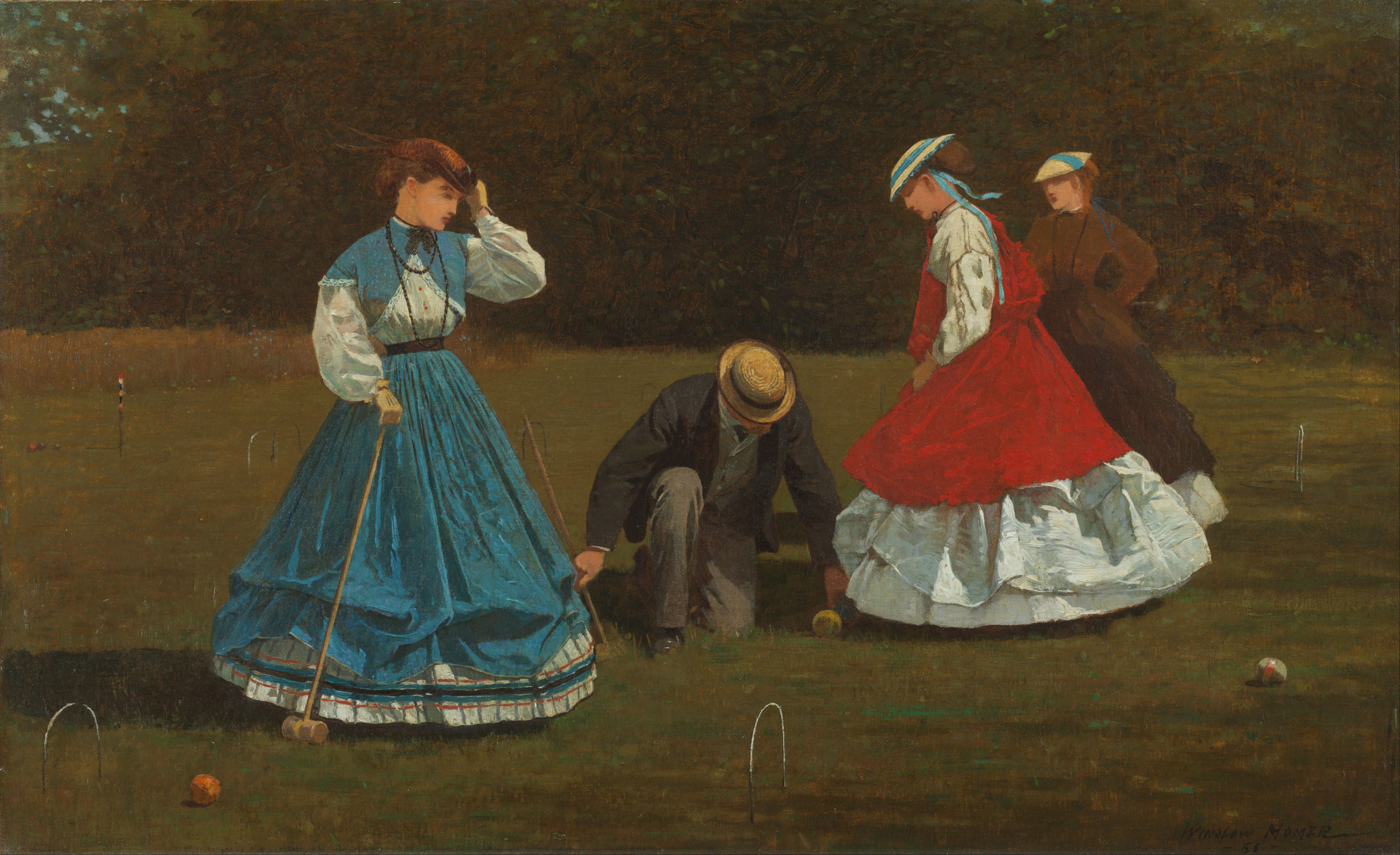
Croquet Scene, painted in 1866 by Winslow Homer (1836 - 1910)
One of America’s master painters, Winslow Homer began his career as an illustrator during the Civil War. In the late 1860s, he turned his acute observational and technical skills toward oil painting, depicting figures bathed in sunlight out-of-doors. These early paintings, often executed in series, feature scenes of upper-class leisure pursuits—in this case, women and men competing with one another in the popular sport of croquet, which had recently been introduced to the United States from the British Isles. In Croquet Scene, one of five paintings Homer completed on the subject, progress on “the grand round” seems fairly advanced. The crouching male figure positions the ball belonging to the woman dressed in red. She is about to croquet (or “send up the country”) another ball, probably belonging to the woman in the left foreground, who shields her eyes against the bright afternoon sun. Notable for its bold patterning, strong contours, and brilliant light effects, the painting epitomizes the spirit of a breezy summer afternoon.
Employed as an illustrator during the Civil War, Winslow Homer began to work in oil paint in 1862, remaining, for the most part, self-taught. His early paintings demonstrate how his skills as a draftsman and printmaker informed his art: graphic qualities such as broad, simple planes and carefully constructed spatial organization appear in many of his works, including Croquet Scene. After the war, Homer became interested in country life, depicting farmers and their families, and the upper-middle class vacationing at summer resorts. In oil paintings, watercolors, and wood engravings, he portrayed these aspects of contemporary American existence with acute observational and technical skills, rarely exaggerating or sentimentalizing his subjects.
Croquet was introduced to America at mid-century from Ireland and England. Homer recorded people enjoying the game as a leisure pastime in a series of paintings, of which the Art Institute’s is an outstanding example. Despite the attention given to the players’ clothing, in the bright sunlight the forms of the four figures seem to flatten out against the lawn and trees behind them. Indeed, the contrast of the dense, dark foliage and the bright hues of the women’s fashionable dresses throw the figures into high relief. As the woman in red prepares to place her foot upon the croquet ball (and then presumably knock away her opponent’s ball), the male figure in the center leans down to adjust the placement of the ball. This gesture could be a chivalrous effort to help the woman maintain her modest pose, or an attempt to view the woman’s ankle. In this way, Croquet Scene embodies Homer’s consummate ability to capture both visual and societal details.
Oil on canvas. 403 x 662 mm; 15.87 x 26.06 in. Signed, lower right: "WINSLOW HOMER/-66-"
Art Institute of Chigago (1942.35). Friends of American Art Collection; Goodman Fund
Provenance
• William Sumner Appleton, Boston, from 1871 to 1903
• by descent to William Sumner Appleton, Jr., Boston
• from 1903. C.C. Childes, Boston, by 1941
• sold to The Art Institute of Chicago, 1942.
Exhibitions
• New York, Macbeth Gallery, An Introduction to Homer, Dec. 15-Jan. 18, 1937, cat. 69.
• New York City, Metropolitan Museum of Art, Life in America, cat. 217.
• Museum of Fine Arts, Boston, Sport in American Art, Oct. 10-Dec. 10, 1944, cat. 56.
• Utica, Munson-Williams-Proctor Institute, Paintings by Winslow Homer and Thomas Eakins, Dec. 1-Jan. 19, 1947, cat. 10.
• Northampton, Mass., Smith College Museum of Art, Winslow Homer: Illustrator, Feb.1951; traveled to Williamstown, Mass., Lawrence Art Museum, Williams College, cat. 30.
• Los Angeles Municipal Gallery, Barnsdall Park, The American Scene 1710-1940, Apr. 17-May 6, 1956.
• Washington D.C., National Gallery of Art, Smithsonian Institution, Winslow Homer, A Retrospective Exhibition, Nov. 23, 1958-Jan. 4, 1959, cat. 9; traveled to New York City, Metropolitan Museum of Art, Jan. 29-Mar. 8, 1959; Museum of Fine Arts, Boston, Mar.-May 1959.
• Washington D.C., National Gallery of Art, Winslow Homer, Oct. 15, 1995-Jan. 28, 1996; traveled to Museum of Fine Arts, Boston, Feb. 21-May 26, 1996, New York City, Metropolitan Museum of Art, June 17-Sept. 22, 1996.
• Metropolitan Museum of Art, "American Stories: Paintings of Everyday Life, 1765-1915," October 12, 2009-January 24, 2010; traveled to Los Angeles County Museum of Art, February 28-May 23, 2010.
Source: commons.wikipedia.org, Do Smit