Camán. 13th century (or even earlier)
English, Nederlands
English
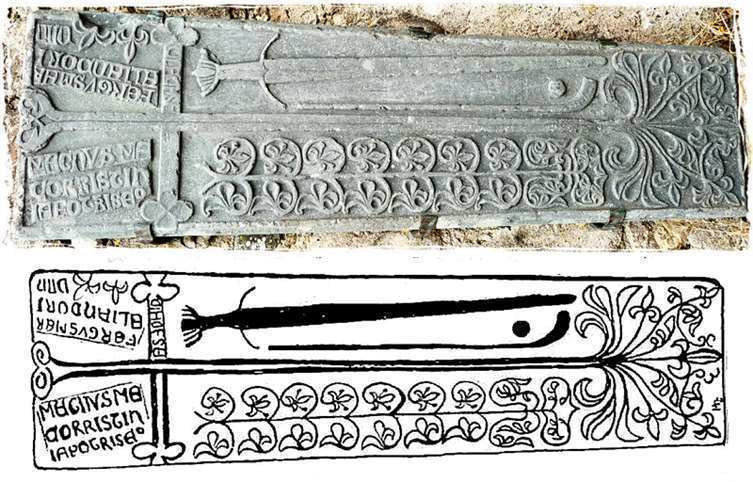
The curious tombstone here depicted was decovered in 1890 buried beneath the brickwork at the east end of the old church at Cloncha, an out-of-the-way village in County Donegal, Ireland. The stone is six feet long and one foot eight inches wide, tapering to one foot five inches at the base. Its ornamentation is distinctly peculiar. A large cross springs from a richly floriated base, and the left side is decorated with a graceful floral design, while on the right side is the quaint combination of a large two-handed sword having a re-curved guard, and beside it a golf club and ball.
On the left arm of the cross is the inscription 'Magnus MacOrristin of the Isles lioes under this mound'. On the right is the inscription 'Fergus MacAlian Dorin in clach sa "----" Fergus MacAlian made this stone'. The inscription, it should be observed, is recognised as being Scottish Gaelic.
The unique nature of the ornament and inscription have caused considerable interest among Irish antiquarians, and it is to the journal for 1898 of the Irish 'Association for the Preservation of the Memorials of the Dead' that I am indebted for the discovery. The importance, however, of the tombstone in relation to golf has so far been ignored. The early history of the Royal and Ancient game has never yet been scientifically and systematically traced, and every piece of fresh evidence in picture, carving, or print, is of "----" value. To judge by the character of the ornament and the style of the sword the work on this tombstone dates as far back as the thirteenth century, and may be even earlier. This stone, therefore, in the remote village of Cloacha bears upon it the oldest known representation of a golf club and ball.
The meaning of the golf club and sword appearing thus side by side is cryptic in the extreme. Was Magnus MacOrristin, of the Isles, a champion like Freddie Tait, a mighty warrior and a mighty golfer to boot? That golf was of serious moment in his life is shown by the presence of this club and ball, not as piece of trilling humour, but placed solemnly side by side with the dead hero's two-handed sword. They remain together above his grave, emblems of peace and war, of a soldier's duty and pleasure. And Fergus MacAlian, who carved the stone, and placed his name proudly beside the other - one likes to think he was something more than a mere craftsman, and to picture him as the friend and opponent or even as the faithful caddie of MacOrriston, of the Isles. 'Requiescat in pace', as good golfers deserve.
It must be remenbered, too, that the inscription is Scottish in character, and it is an interesting speculation that golf if of ever remoter origin than has ever been supposed, and that in the early days two Scottish chiefs carried their national game across the sea. The origin and meaning of the tombstone must remain wrapped in mystery, but there in little Cloncha Church are the club and ball, emblems of golf, carved centuries ago and yet plain as clear as though cut by a stonemason of t-day.
By Martin Hardie
Nederlands
'... is een 15e eeuwse grafsteen uit Clonca, Inishowen, Co. Donegal. De overledene was een Schotse huursoldaat die uit Iona afkomstig was. Op de steen zijn niet alleen zijn typisch Schotse zwaard afgebeeld, maar ook een camán en bal. De camán doet sterk denken aan het huidige type dat bij camanachd/shinty wordt gebruikt.'
Literatuur
● Jan N. Lanting, Combineren en deduceren, p. 201; Fig. 15 p. 202
Source: Pius Muskens, Jan N. Lanting